
Google Reviews and Local SEO: Why They Matter for Small Businesses
You probably already know reviews matter.
You look at them before trying a restaurant.
Before hiring someone to work on your house.
Before booking a hotel.
Before buying the weird little gadget Google convinced you would change your life.
Your customers do the same thing.
For a local business, reviews aren't just nice comments sitting on the internet.
They're part of your reputation, your Google Business Profile, and your local SEO.
Reviews help people make decisions
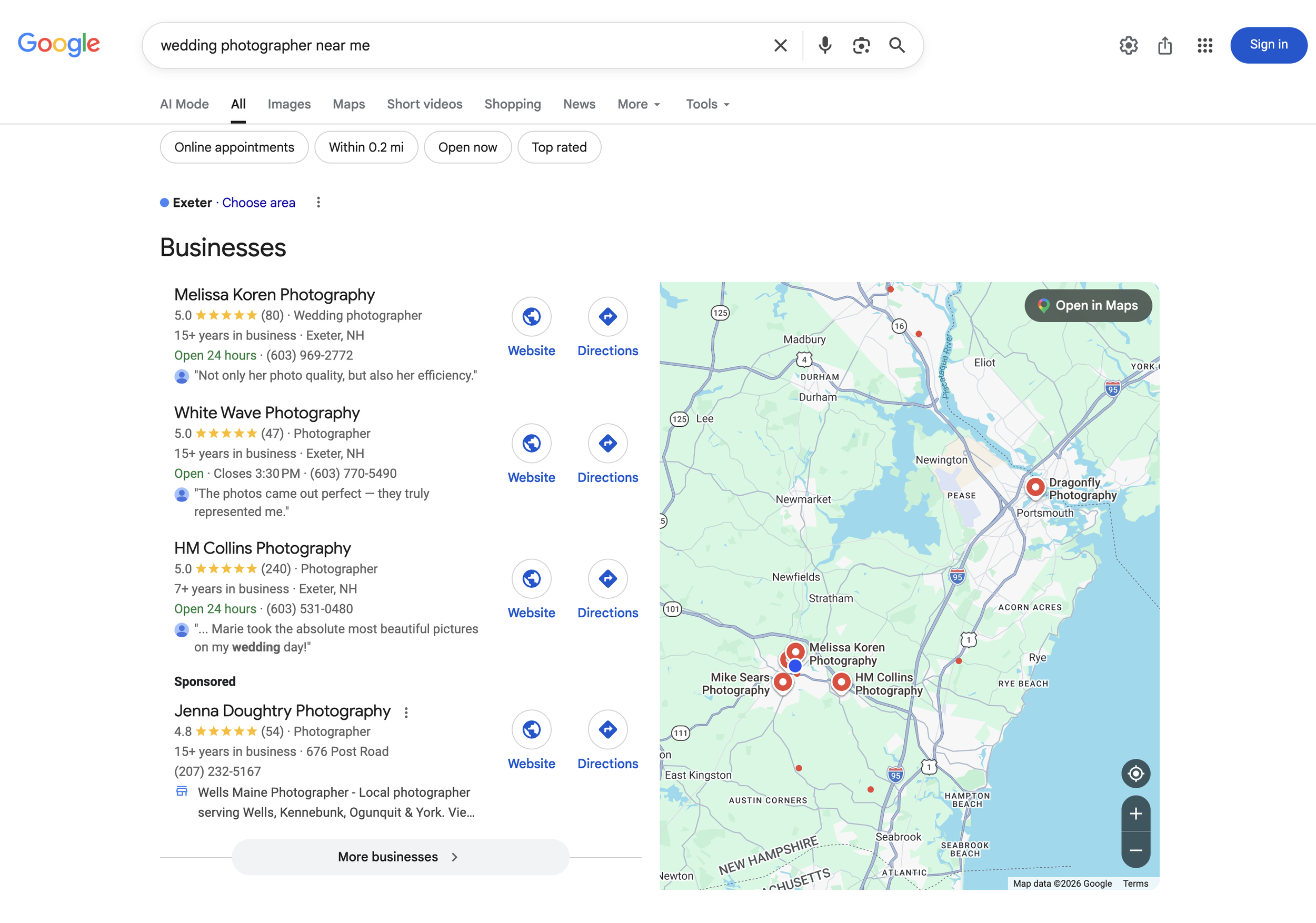
Imagine two businesses appear in the same Google search.
One has three reviews.
The other has 67.
Both have great websites.
Both offer what you're looking for.
Which one are you more likely to investigate first?
Reviews create context before someone ever contacts you.
They help answer questions like:
Is this business reliable?
Do people like working with them?
Are they experienced?
Do they actually provide the service I'm looking for?
Do their customers sound like me?
That last one matters more than people realize.
A detailed review from someone who hired you for the exact service another person is searching for can be incredibly persuasive.

Google bot crawlers like when you Amaze! Amaze!
Reviews also give Google useful information
Google is constantly trying to understand businesses.
What do they do?
Where are they?
Are they active?
Do customers seem satisfied?
Reviews contribute to that overall picture.
The language customers use can also reinforce what your business does.
Someone might write that you created their new website in Exeter.
Another might mention professional headshots for their Portsmouth team.
Someone else may talk about the marketing support you provided for their New Hampshire small business.
You didn't write those phrases for SEO.
Your customers did.
That's one reason authentic reviews are so useful.
Reviews matter beyond traditional Google search, too
The way people search for businesses is changing.
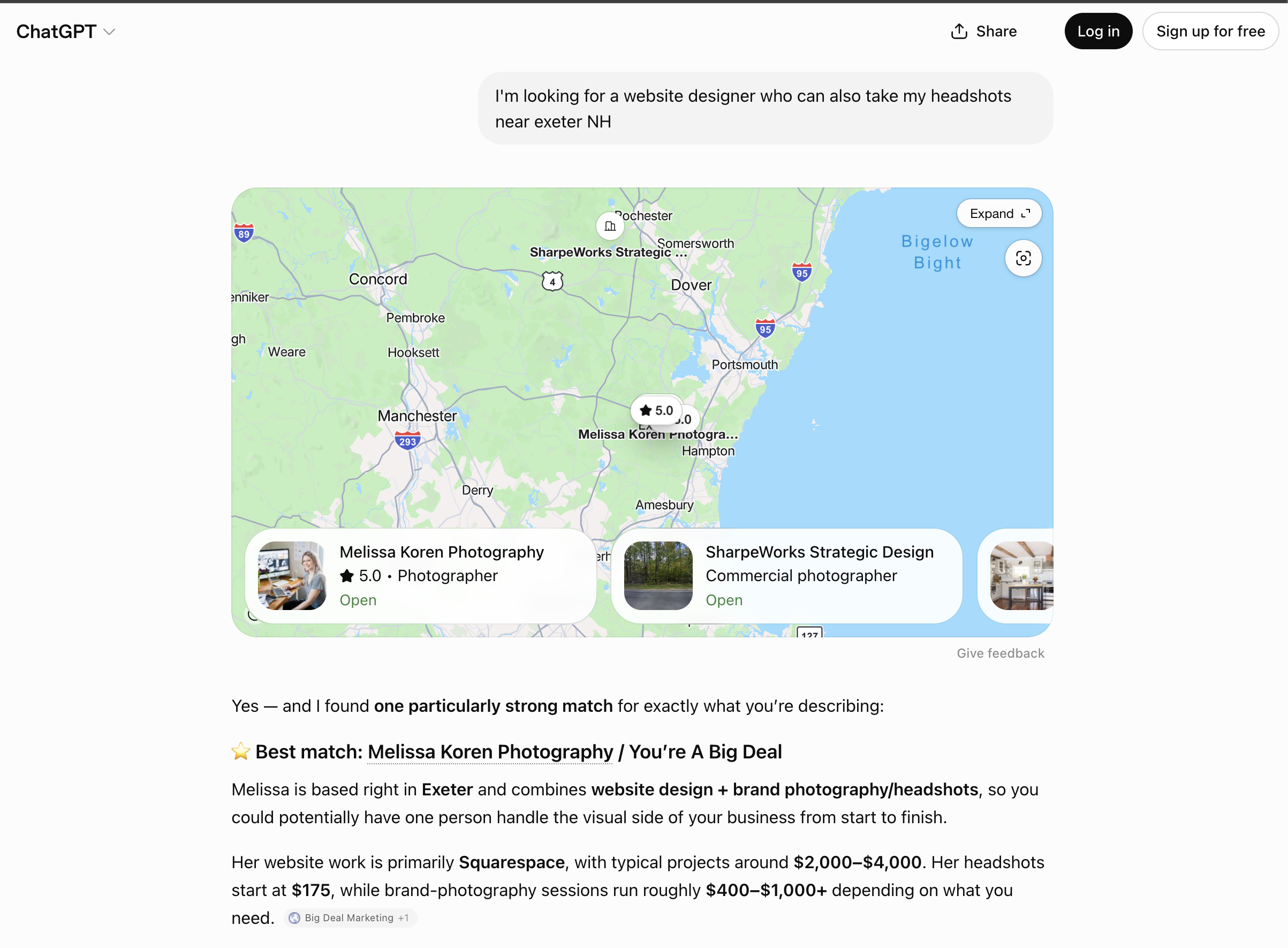
People aren't only typing "website designer Exeter NH" into Google anymore.
They're asking ChatGPT and other AI tools questions like:
"Who can build a Squarespace website for my small business near Exeter?"
"Who does small business marketing in Portsmouth?"
"Can you recommend a local brand photographer on the New Hampshire Seacoast?"
And I know this isn't hypothetical because people have found my businesses through ChatGPT.
That doesn't mean you need to start stuffing your website with weird AI-friendly language.
Quite the opposite.
Your website, Google Business Profile, reviews, service pages, location information, and other mentions of your business should make it easy to understand who you are, what you do, where you work, and who you help.
That clarity matters to people.
It matters to Google.
And increasingly, it matters to AI tools that are helping people research and discover businesses.
You don't need to write your website for robots.
You need to make your business easy to understand.
You don't need hundreds of reviews
This is where small businesses sometimes get intimidated.
You see a national company with 4,000 reviews and assume you've already lost.
You haven't.
Local search is local.
If someone is looking for a business in Exeter, Portsmouth, Hampton, Newmarket, or elsewhere on the New Hampshire Seacoast, they're comparing the businesses relevant to that search.
A steady collection of recent, genuine reviews can be far more useful than chasing some arbitrary giant number.
I'd rather see a business consistently receive a few thoughtful reviews than get 25 reviews during one big push and then nothing for three years.
The best time to ask is when the experience is fresh
Asking for a review does not have to be awkward.
The easiest time is usually after something good has just happened.
The project was completed.
The website launched.
The photos were delivered.
The problem was solved.
The customer thanked you.
That's your opening.
You don't need a five-paragraph speech.
Something as simple as:
I'm glad you're happy with everything. If you have a minute to leave your kind words in a Google review, it really helps people find my business!
That's enough.
Make it easy
If you want reviews, don't make customers search for where to leave one.
Send the direct review link.
Put it in your project completion email.
Include it in your client workflow.
Add it to a follow-up template.
For businesses with a lot of customer interactions, make asking for a review a normal part of the process, not something you remember twice a year.
Good marketing systems remove the need to remember everything manually.
Don't tell people what to write
You can ask someone to mention what service they used if they want a little direction.
You shouldn't hand them a paragraph full of keywords to paste into Google.
Besides being awkward, that misses the point.
The best reviews sound like customers.
Some will be short.
Some will tell a whole story.
Some will mention things you never would have thought to highlight yourself.
That's useful.
Respond to your reviews
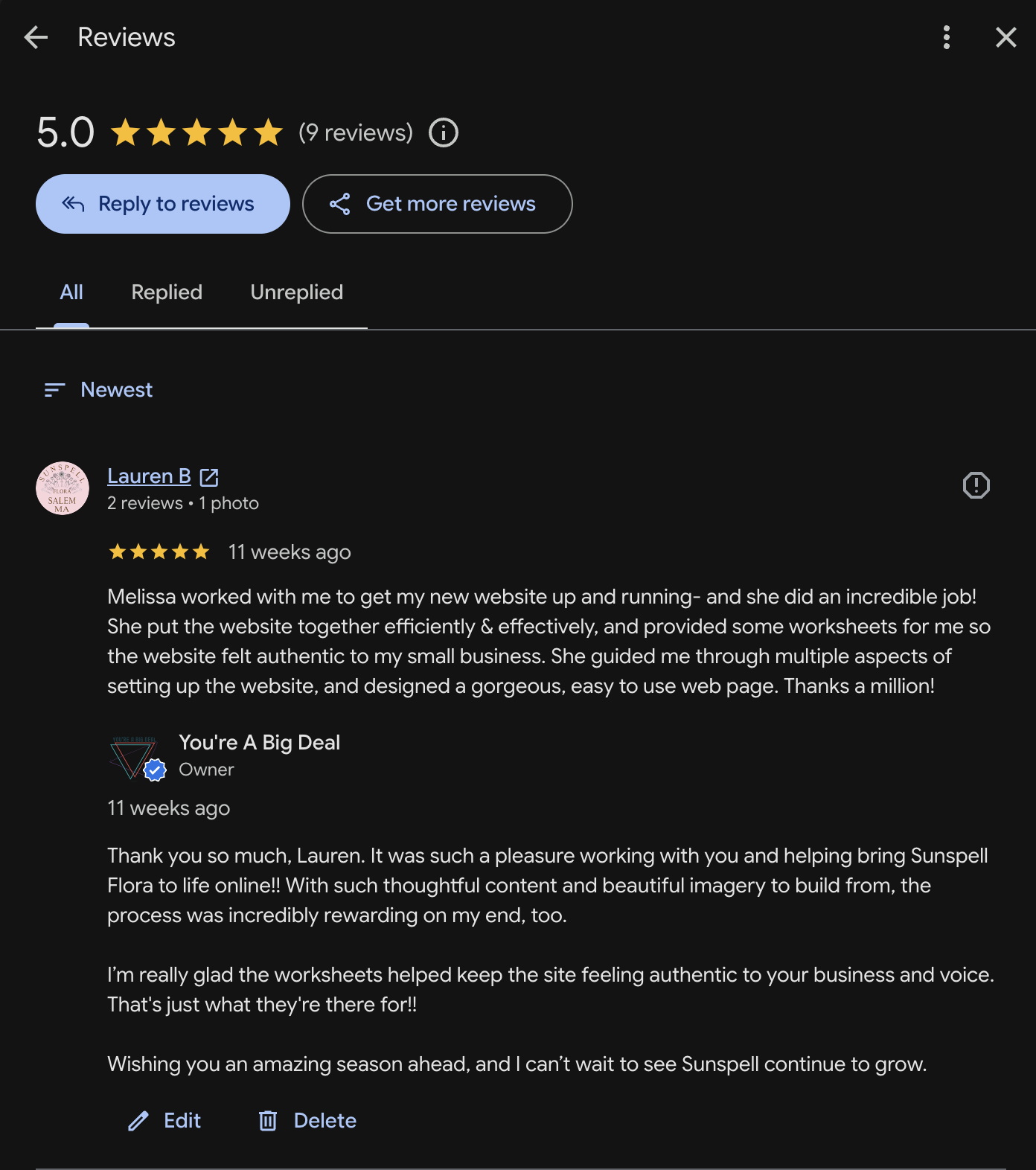
If someone took the time to review your business, respond.
You don't need to write a novel.
A simple, specific reply shows that there's an actual person behind the business.
Instead of:
Thanks for the review!
Try:
Thank you, Sarah. I loved working with your team on the new website and I'm glad the process felt manageable.
That response is more personal and gives future readers additional context.
Negative reviews deserve responses too.
Stay calm.
Address what you can.
Don't start a public courtroom drama in the Google review section.
Future customers are reading how you handle the situation as much as they're reading the complaint itself.
Use great reviews beyond Google
A strong review doesn't have to stay buried on your Google Business Profile.
With permission and appropriate attribution, reviews can become useful proof throughout your marketing.
They can appear on:
Your homepage
Service pages
Project case studies
Social media
Proposals
Email marketing
Match the testimonial to the service whenever possible.
A website testimonial belongs on the website design page.
A brand photography review belongs near your photography work.
That context makes the review more useful than dumping every testimonial onto one giant page and hoping people read them.
Reviews can't fix a confusing business
Reviews support your marketing.
They don't replace it.
You still need a website that clearly explains what you do.
A Google Business Profile with accurate information.
Good photography.
Useful service pages.
Consistent business information.
A way for someone to contact you without solving a puzzle.
Being findable online works best when all of those pieces agree with each other.
That's the recurring theme with marketing.
Very few individual tactics are magic.
The value comes from making them work together.
Wrap-up
You don't need to turn asking for reviews into a campaign.
Make it part of the way you do business.
Ask when the timing makes sense, make the process easy, respond like a human, and let your customers' experiences add another layer of trust to your online presence.
If your Google Business Profile, website, reviews, local SEO, and content all feel like separate projects you're trying to keep track of, that's exactly the kind of thing I help untangle.
I work with small businesses throughout Exeter, Portsmouth, and the New Hampshire Seacoast to build practical marketing systems that are easier to manage and easier for customers to find.
-
Yes. Google reviews are one part of your overall local search presence. They also give potential customers useful information about your business, services, and customer experience.
-
Potentially, but reviews alone aren't the deciding factor. ChatGPT Search can use information available across the web when answering questions and recommending relevant sources. A clear website, consistent business information, useful content, and an accessible site all help establish what your business does and where you work.
-
There isn't a magic number. It's better to make asking for reviews a regular part of your customer process so you're gradually collecting current, authentic feedback instead of doing one giant review push every few years.
-
Don't give customers a script. If they want direction, ask them to share what service they used and what their experience was like. Their own words are more useful and believable than a keyword-filled review you wrote for them.
-
Make sure your website clearly explains what you do, where you work, and who you help. Keep your Google Business Profile accurate, collect genuine reviews, publish useful content, and make sure your business information is consistent across the web.